
Introduction:
The job market is changing quickly and the skills that employers value today are not limited to traditional degrees. In Pakistan digital transformation, software services, online business and modern workplace tools are creating new opportunities for people who build practical and relevant skills.
If you are a student, fresh graduate job seeker or working professional, learning the right skill can help you compete for better opportunities. This does not mean that every person needs to become a programmer. The better approach is to understand which skills are gaining attention and then choose one that matches your education, interest and career plans.
Pakistan’s IT and digital economy continues to develop. The Pakistan Economic Survey 2025-26 reported strong growth in the IT and telecommunications sector and stated that ICT export remittances reached US$3.38 billion during July–March FY2026. The government also supported training in areas including AI, freelancing and advanced digital skills. (Finance Division)
What Are High-Demand Skills?
High-demand skills are abilities that employers and clients increasingly need for their businesses and projects. They can be technical skills such as software development and data analysis or practical professional skills such as communication, project management and problem-solving.
Demand can vary by industry. A skill that is useful for an IT company may not be the most important skill for a bank, hospital manufacturing company or education organization. Therefore, career planning should focus on the combination of skill + industry knowledge + practical experience.
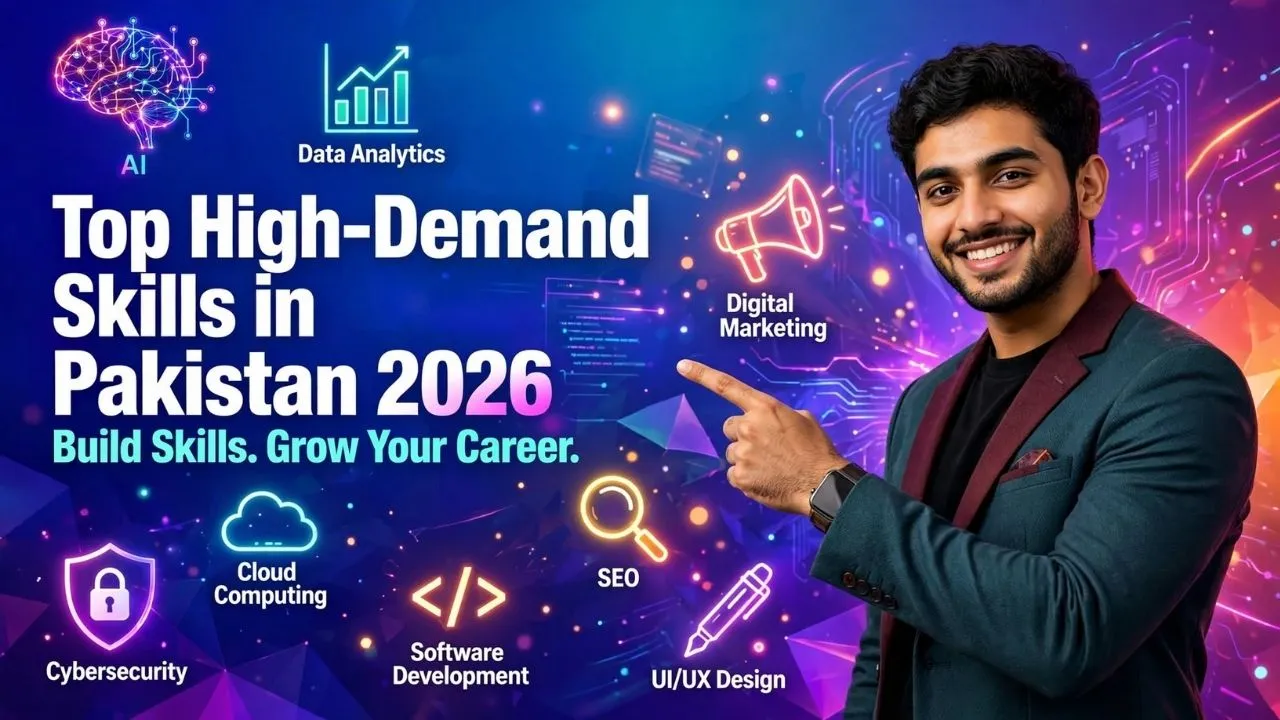
Top High-Demand Skills in Pakistan 2026
| Skill | Where It Can Be Used | Suitable Career Areas |
|---|---|---|
| Artificial Intelligence | Software, business, automation and research | AI Developer, AI Specialist |
| Data Analytics | Business, finance, marketing and operations | Data Analyst, BI Analyst |
| Software Development | Web, mobile and business applications | Software Developer |
| Cybersecurity | Networks, systems and digital services | Security Analyst |
| Cloud Computing | IT infrastructure and applications | Cloud Engineer |
| Digital Marketing | Online businesses and brands | Digital Marketer |
| SEO | Websites and online businesses | SEO Specialist |
| UI/UX Design | Websites, apps and digital products | UI/UX Designer |
| Video Editing | Marketing, social media and media | Video Editor |
| Communication & Soft Skills | Almost every professional field | Sales, Management, Customer Service |
Artificial Intelligence and AI Literacy
Artificial Intelligence is one of the most important technology areas for professionals to understand in 2026. However, learning AI does not necessarily mean becoming a machine learning engineer.
For beginners, AI literacy can include understanding how AI tools work, writing effective instructions, checking AI-generated information and using AI responsibly in everyday tasks. For technical learners the path can go deeper into Python, machine learning data processing and AI application development.
P@SHA has identified AI and emerging technologies as important areas for Pakistan’s future IT workforce and has highlighted the need for stronger AI readiness and practical industry-aligned skills. (P@SHA)
Best for: IT students, developers analysts, researchers marketers and professionals who want to improve productivity.
Data Analytics and Business Intelligence
Businesses generate large amounts of information every day. The ability to organize that information and turn it into useful insights is becoming increasingly valuable.
A beginner can start with Excel and basic data handling before moving toward SQL, Power BI or other analytics tools. More advanced learners can explore Python, statistics and data visualization.
Data analytics can be useful in banking, retail, healthcare marketing, finance logistics and many other sectors.
A practical learning path can be:
- Excel fundamentals
- Data cleaning
- Basic statistics
- SQL
- Data visualization
- Power BI or another BI platform
- Portfolio projects
Software Development
Software development remains an important career direction because businesses need websites, applications, internal systems and digital services.
Students can choose different development paths depending on their interests. These may include frontend development backend development, full-stack development mobile application development or specialized software engineering.
Pakistan’s IT industry continues to focus on software development and other technology capabilities. P@SHA’s skills research also emphasizes the gap between academic learning and practical employability which means learners should combine theoretical knowledge with hands-on projects. (P@SHA)
Useful areas to learn include:
- HTML and CSS
- JavaScript
- Python
- Java
- .NET
- React
- Backend development
- Databases
- APIs
- Git and version control
You do not need to learn all of these at once. Choose one development path and build strong foundations first.
Cybersecurity
As organizations depend more on digital systems, protecting information networks and applications becomes increasingly important.
Cybersecurity includes areas such as network security, security monitoring vulnerability assessment, identity management and incident response.
This field requires continuous learning because security threats and technologies keep changing. Beginners should first understand networking operating systems and basic security concepts before moving toward specialized areas.
Suitable for: IT graduates, computer science students network professionals and people interested in information security.
Cloud Computing
Cloud computing has grown to be a significant component of contemporary IT infrastructure. Companies use cloud platforms for applications, storage computing resources and digital services.
People interested in cloud careers can begin with basic networking and operating-system knowledge. They can then explore platforms such as AWS, Microsoft Azure or Google Cloud.
A good cloud learning plan should include both theory and practical work. Creating small projects and learning how applications are deployed can provide a stronger understanding than watching lessons alone.
Digital Marketing
Digital marketing remains a practical skill for businesses that want to reach customers through online channels.
The field includes search marketing, social media marketing, content strategy paid advertising, analytics and email marketing.
Pakistan’s DigiSkills program currently lists Digital Marketing among its free training courses and its Digital Marketing course covers areas including Meta advertising TikTok advertising, Google Ads keyword research and analytics.
People can build skills in:
- Social media marketing
- Search engine marketing
- Content planning
- Google Ads
- Meta Ads
- Analytics
- Email marketing
- Campaign reporting
Search Engine Optimization (SEO)
SEO is useful for businesses, publishers and website owners who want their content and pages to be easier to discover through search engines.
A good SEO learner should understand keyword research, search intent technical basics, content quality, internal linking website performance and measurement.
SEO should not be treated as simply adding keywords to an article. Modern SEO requires useful content, clear structure and an understanding of what users are actually searching for.
UI/UX Design
Websites and applications need to be easy to understand and comfortable to use. This is where UI and UX skills become valuable.
UI focuses on the visual interface while UX is more concerned with the overall user experience and how people interact with a product.
A beginner can start by learning design principles, wireframing and prototyping. Building sample app screens and website layouts can help create a portfolio.
DigiSkills currently includes UI/UX & Webflow among its available training areas. (DigiSkills)
Video Editing and Content Creation
Video has become an important format for websites, social platforms businesses and online education.
A video editor can work on short-form videos, promotional content educational material, social media clips and other digital projects.
The important point is to learn more than basic cutting and joining. Strong editing also involves storytelling, pacing, audio, captions, visual consistency and understanding the purpose of the video.
Communication and Soft Skills
Technical knowledge alone does not guarantee career progress. Employees also need to explain ideas communicate with colleagues, understand instructions and handle professional situations.
Important soft skills include:
- Written communication
- Verbal communication
- Problem-solving
- Teamwork
- Time management
- Adaptability
- Critical thinking
- Professional behavior
- Presentation skills
- Client communication
P@SHA’s research also covers non-technical training needs and highlights the importance of cognitive and soft skills alongside technical abilities. (P@SHA)
Freelancing and Remote Work Skills
Freelancing is not a single technical skill. It is a combination of a marketable service and the ability to find, communicate with and serve clients.
A freelancer may offer services such as:
- Graphic design
- SEO
- Web development
- Digital marketing
- Data analytics
- Video editing
- Virtual assistance
- Content writing
Pakistan has continued to invest in digital and freelancing training. According to the Pakistan Economic Survey 2025-26, DigiSkills conducted more than 5.14 million trainings during July–March FY2026 and freelancers trained under the program earned approximately US$1.65 billion. (Finance Division)
These figures do not mean that every learner will earn a particular amount. Results depend on skill level, service quality, communication, competition and the ability to find suitable clients.
Which Skill Should You Learn First?
| Your Background | Skills You Can Consider |
|---|---|
| Computer Science Student | Software Development, AI, Data Analytics |
| Business Student | Digital Marketing, Data Analytics, Business Intelligence |
| Commerce Student | Excel, Accounting Software, Data Analytics |
| Creative Person | Graphic Design, UI/UX, Video Editing |
| Website Owner | SEO, Content Strategy, Digital Marketing |
| Job Seeker | Communication, Excel, Industry-Specific Skill |
| IT Professional | Cloud, Cybersecurity, AI |
| Beginner | Digital Literacy, Excel, Communication, One Specialized Skill |
How to Build a Useful Skill in 2026
Learning a skill is only the first stage. You should also learn how to demonstrate it.
1: Select One Main Skill
Do not start five courses at the same time. Pick one area and give yourself enough time to understand its basics.
2: Learn the Fundamentals
Understand the concepts before moving toward advanced tools. Strong basics make it easier to adapt when software and technologies change.
3: Practice With Real Projects
Create sample work related to your chosen field. For example, a data learner can analyze a public dataset while a web developer can create a small website.
4: Build a Portfolio
A portfolio gives employers or clients something practical to review. It can include projects, case studies designs, websites, reports or other relevant work.
5: Improve Communication
Learn to explain what you created, what problem it solves and what tools you used.
6: Start Applying
Use job platforms and professional networks to understand what employers are asking for.
ROZEE.PK Jobs in Pakistan offers job listings and filters for skills, cities, experience and industries. (Rozee)
LinkedIn Jobs in Pakistan can also be used to explore professional roles, internships and opportunities across different fields. (LinkedIn)
For government career opportunities, National Jobs Portal Pakistan provides verified government job listings and allows users to search by job title, keywords and location. (National Job Portal)
Free and Useful Learning Options in Pakistan
People who cannot afford expensive training programs can start with free or low-cost resources.
DigiSkills Pakistan currently lists courses including Freelancing, Digital Marketing, SEO, Virtual Assistant, Data Analytics & Business Intelligence, Artificial Intelligence with Python, Cloud Computing, Full Stack Development and UI/UX & Webflow. (DigiSkills)
The program states that its training is free and its courses include Urdu and English learning content. (DigiSkills)
Another useful approach is to combine an online course with documentation, practice projects and industry-related job descriptions. This helps you understand what employers actually expect.
Common Mistakes When Learning a New Skill
Many learners spend months watching tutorials but do not become ready for practical work. Avoid these common mistakes:
- Attempting to acquire too many things at once
- Collecting certificates without practical projects
- Ignoring communication skills
- Copying portfolio projects without understanding them
- Choosing a field only because someone says it pays well
- Not checking current job requirements
- Stopping after completing one course
- Ignoring basic computer and digital skills
- Using AI tools without checking their output
- Expecting immediate results
Why Practical Skills Matter More Than Certificates Alone
A certificate can show that you completed a course but it does not automatically prove that you can perform the work.
For example, someone applying for a digital marketing role should ideally understand campaign planning, reporting and analytics rather than only having a course certificate.
Similarly, a software developer should be able to demonstrate working projects and a data analyst should be able to explain how they cleaned and interpreted data.
This is why a strong career plan should combine:
Learning + Practice + Portfolio + Communication + Applications
Career Tips
Do not select a skill only because it is called a “high-income skill.” First ask whether you can realistically spend several months learning and practicing it.
If you enjoy technology, technical fields may suit you. If you are more interested in business, sales or marketing, digital marketing and business-related skills may be a better match. Creative learners can explore design and video while people who prefer structured work can consider data, finance or administrative technology skills.
Learning every new technology is not the aim. The goal is to become genuinely useful in one area and then add supporting skills around it.
FAQs
What are the most useful skills to learn in Pakistan in 2026?
AI, data analytics, software development, cybersecurity, cloud computing, digital marketing, SEO and communication are useful career skills.
Which skill is best for beginners?
Choose one skill based on your interest and start with basic learning and practical projects.
Can I learn high-demand skills without a degree?
Yes. Many skills can be learned through online courses, practice and real projects.
Is AI replacing professional skills?
AI is changing many jobs but strong basic knowledge and practical skills are still important.
Where can I find jobs after learning a skill?
You can search on ROZEE.PK, LinkedIn and the National Jobs Portal for suitable opportunities.
Final Thoughts
The career market in Pakistan is moving toward a combination of technical ability, digital awareness and strong professional skills. There is no single skill that guarantees a successful career. What matters is choosing a suitable direction, learning the fundamentals and repeatedly applying your knowledge through practical work.
If you are starting from zero, do not feel pressured to learn everything at once. Choose one skill, create a realistic learning routine and build evidence of what you can do.
For more career guidance, job updates and useful employment information, readers can also visit ExpertJobs26.com and explore the latest resources published for job seekers.
1 thought on “Top High-Demand Skills in 2026, Pakistan | Career Tips”